A group is never a single visitor
People arrive at immersive experiences with different expectations. Some want to investigate everything, some prefer to stay near friends, and some need time to understand an unfamiliar setting. Designing for a group means making these differences workable. It does not mean forcing everyone into the same role or assuming that enthusiasm is evenly distributed.
The personal journey and the collective journey operate at different scales. An individual might notice a detail, make a decision or form a connection with a character. A group might negotiate a plan, witness a shared reveal or compare discoveries. Experience design becomes richer when these scales support each other rather than compete for attention.
Start by describing the intended relationship between participants. Are they collaborators, parallel explorers, witnesses or temporary opponents within a game? A group gathered in one room is not necessarily having a social experience. There needs to be a reason to attend to one another, and that reason should connect to the purpose of the experience.
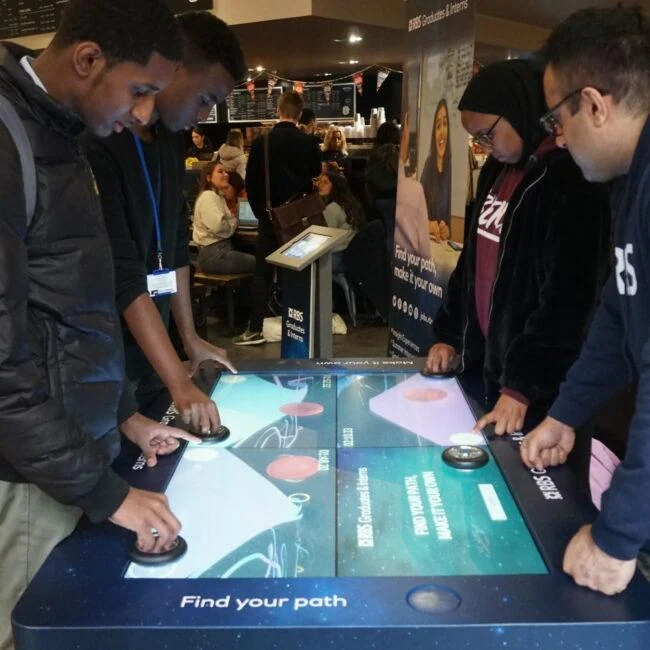
- Arrival
- Personal route A
- Personal route B
- Personal route C
- Reconnection
- Shared meaning
Illustrative design model, not a project floor plan.
Three useful journey patterns
A shared route keeps the group together through a sequence of encounters. It makes coordination easier and can support a common emotional rhythm. The challenge is preserving personal involvement when everyone receives similar information. Offer different things to notice, moments of individual reflection or small choices within the common route.
Parallel paths allow people to separate and reconnect. They can create distinctive memories without requiring a completely different story for every visitor. Plan the reunion carefully: where does it happen, how will participants find it, and what makes their separate discoveries relevant? A reunion that merely waits for the slowest person misses the social opportunity.
Distributed knowledge gives different people parts of a larger picture. The group can understand or complete something only by exchanging information. This can be powerful, but it needs support for quieter participants and incomplete attendance. Avoid making one person's missed clue an unavoidable failure for everybody else unless that consequence is an intentional, clearly framed part of a game.
Balance individual agency and shared progress
Agency means having a meaningful relationship to what happens. It can come from a consequential decision, but also from choosing where to look or deciding how to interpret something. Give visitors enough feedback to recognise that relationship. A choice whose effect is invisible may feel less meaningful than a small action with a clear response.
Consider whether the fastest or loudest participant can take over. Shared touchscreens, group puzzles and performer-led choices can concentrate attention in one person. Separate responsibilities, provide multiple points of entry or ask for contributions in turn. The exact method depends on the format, but the principle is to make participation available rather than merely permitted.
Do not equate observing with disengagement. Someone may be intensely involved while choosing not to speak or act. Offer an observer route where possible and make it legitimate within the framing. A well-designed group immersive experience can accommodate active contribution and reflective attention without treating one as the correct personality.
Use gathering moments with purpose
A gathering moment should change the experience. It might reveal that several clues describe the same event from different perspectives. It might allow the group to transform a shared display, or invite them to decide what should happen next. The most useful question is what becomes possible together that was not possible alone.
Give the moment an understandable shape. Visitors need to know where to gather, what information matters and how much time they have. A host, sound cue or environmental change can support this transition. Avoid relying on an announcement that is inaudible in a crowded room or assumes everyone is already watching the same screen.
A quiet gathering can be as effective as a spectacular finale. Several people listening to a short account after exploring a place may create a strong connection. Match the scale of the moment to the story. Shared meaning comes from recognising a relationship, not necessarily from delivering the largest effect in the production.
Design for companions and strangers
Friends bring existing relationships into the experience. They may joke, compare reactions or resist separation. Strangers may need clearer invitations and lower-pressure ways to collaborate. Decide how much social exposure the format expects, and describe that expectation before participation. An unexpected demand to perform publicly can change someone's experience of the entire visit.
Provide alternatives when an activity depends on touch, speech, movement or direct eye contact. A written contribution, a choice through an object or an observer role may preserve the narrative purpose. Think about how the alternative fits into the shared flow, so visitors are not made conspicuous simply because they participate differently.
Family and mixed-age groups add another layer. Reading speed, reach, prior knowledge and patience vary. Design common tasks with contributions of different kinds, rather than assuming an adult will interpret everything for others. Clear visual cues and tangible actions can support participation, but the experience still needs to respect the complexity of the subject.
Test social behaviour in the prototype
A solo demonstration cannot reveal group dynamics. Test with people who know one another and with people who do not. Watch who speaks, who waits, who controls the interface and who loses track of the story. Ask visitors to recount what happened individually before collecting a group response; otherwise confident voices may shape everyone's account.
Observe the transitions between personal and shared moments. Can people reconnect without staff repeatedly intervening? Do they understand why another person's discovery matters? Does the ending reward curiosity without punishing those who took a different route? These observations are concrete material for refining the journey.
The goal is not identical enjoyment or unanimous interpretation. It is a coherent shared experience that leaves space for individual meaning. When visitors say, “I saw something different,” that can be the beginning of the design's success, provided there is a worthwhile way for their perspectives to meet.
Put this guide into practice
Plan a focused visitor review
Choose one part of the journey that matters to personal journeys in a group. Describe what the visitor should notice, understand or do.
Observe the encounter
Try the encounter with someone unfamiliar with the concept. Record their actions and interpretation before explaining the intended design.
A question for the review
How can a quieter participant contribute to the shared moment?
Sources & further reading
Practical design suggestions are Youmersive’s editorial guidance. Named projects are attributed to their creators; references do not imply a partnership.