Begin with the collection and its questions
An immersive museum experience can help visitors encounter a subject through space, sound and participation. Its purpose should grow from the collection or story being interpreted. A striking room may attract attention, but the interpretation becomes stronger when visitors can understand why its atmosphere, objects and activities belong to this particular subject.
Ask what the collection makes possible. An object might open a discussion about daily life, movement, craft or power. A place might reveal conflicting memories. A scientific process might become easier to understand through a shared model. These opportunities suggest the experience's structure before a display technology is selected.
Visitors do not arrive with identical knowledge. Some seek detail, others follow a companion's curiosity, and some discover the subject unexpectedly. Design several depths of engagement around a coherent central idea. The first layer should be understandable without specialist preparation, while deeper layers reward attention rather than merely adding more text.
Interpretation through personal discovery
Personal discovery can come from choosing which testimony to hear, comparing objects or examining a detail closely. These actions let visitors shape their understanding without needing a different factual account for each person. The task is to make the relationship between discoveries visible enough that the experience does not fragment into unrelated activities.
A useful pattern is a shared question with several routes through the evidence. Visitors might examine material traces, personal accounts and historical context separately before reconnecting. The final conversation can reveal why those perspectives belong together. This approach respects personal attention while preserving the intellectual structure of the exhibition.
Separate evidence from creative reconstruction
Immersive interpretation can make the past feel immediate, which increases the importance of clear attribution. Distinguish documented facts, informed reconstruction and fictional framing. A voice performance or digital environment may be a creative interpretation rather than an exact recovery of historical experience. Let visitors understand that distinction without undermining the narrative.
When several communities hold different accounts, resist reducing them to a single convenient storyline. Where appropriate, involve people connected to the subject in developing the interpretation. Participation by visitors during an exhibition is different from participation in its authorship; both can matter, but they should not be presented as the same process.
A real example: 7 Herbs
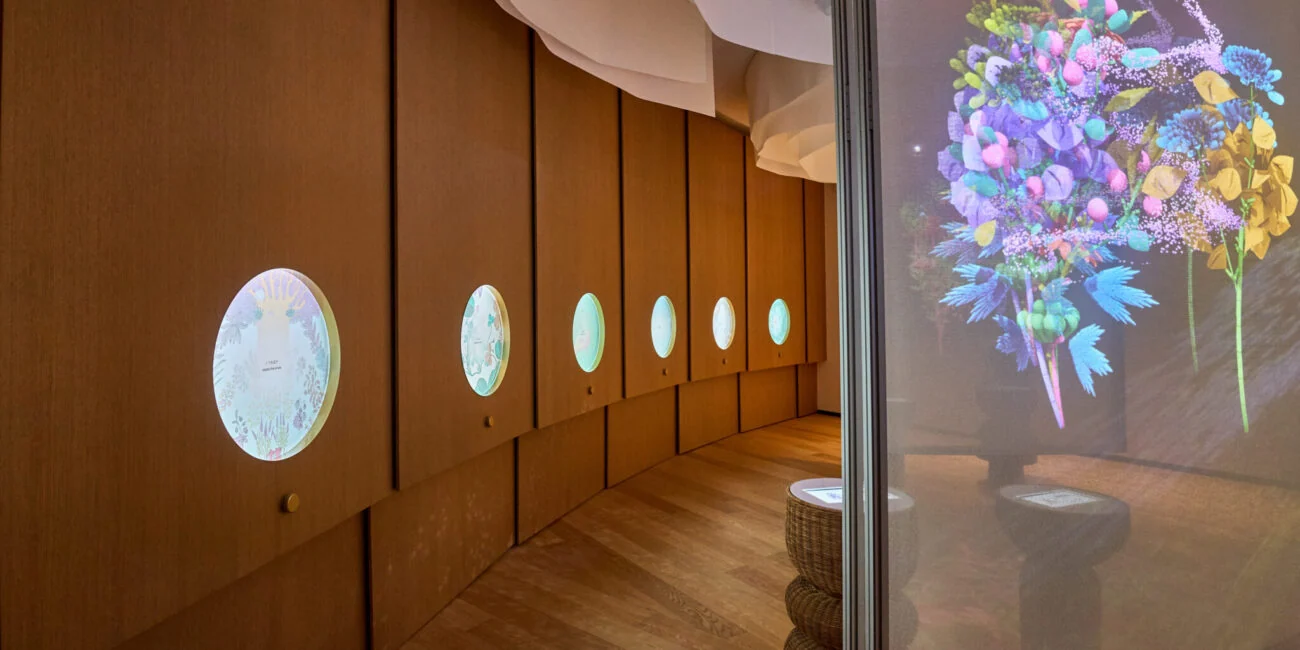
Munchingsquare's 7 Herbs project at the Poland Pavilion for Expo 2025 used circular displays to present an animated herbarium. The official account connects Polish herbal traditions with a Japanese seven-herbs custom. It also describes the studio's role in making the technology consistent and maintainable across the installation.
The image offers a concrete reference for individual attention within a shared exhibition environment. A visitor can examine a particular display while others explore nearby. The design lesson is to connect distinctive visual presentation with content that supports the subject, and to consider practical operation as part of interpretation rather than a separate concern.
Design for companions
Museum visits are often social. People point out details, share prior knowledge and move at different speeds. An interactive should leave room for that behaviour. Place controls and viewing positions so one visitor does not unnecessarily block everyone else's view, and provide enough context for companions to understand what is happening.
Group tasks can invite conversation, but participation should have a reason. Comparing interpretations may fit a historical subject; combining observations may fit a scientific one. Avoid making a collaborative activity depend entirely on fast reading or confident public speech. Several forms of contribution can help a group share the experience more fairly.
Consider dwell time and circulation
An exhibit must work within the rhythm of the venue. Some visitors will stay for a minute; others may explore longer. Give the short encounter a complete idea and the longer encounter a worthwhile extension. If the experience requires a fixed sequence, communicate its duration and provide a clear start and finish.
Watch how groups gather around the installation during testing. A successful interaction can still create a circulation problem if everyone stands in a doorway or cannot see the result. Evaluate sightlines, sound spill and the relationship to neighbouring displays. The surrounding exhibition is part of the experience, even when the installation is technically self-contained.
Leave visitors with a question worth carrying
The ending of an immersive museum encounter need not deliver a single conclusion. It can reveal the complexity of an object, invite a comparison or suggest a question to discuss with a companion. Connect the exit to the collection, relevant further reading or another part of the venue.
Evaluate understanding as well as engagement. Ask visitors what they think the installation was about and what detail stayed with them. A long dwell time can mean fascination, confusion or waiting for a control. Combining observation with visitors' own accounts gives the team a better basis for improving the experience.
Put this guide into practice
Plan a focused visitor review
Choose one part of the journey that matters to museums & heritage. Describe what the visitor should notice, understand or do.
Observe the encounter
Try the encounter with someone unfamiliar with the concept. Record their actions and interpretation before explaining the intended design.
A question for the review
Can a visitor distinguish evidence from creative interpretation?
Sources & further reading
Practical design suggestions are Youmersive’s editorial guidance. Named projects are attributed to their creators; references do not imply a partnership.